33 Results for "

Cynanchum otophyllum C. K. Schneid.

" in MedChemExpress (MCE) Product Catalog:
Products (33)

33 Results for "Cynanchum otophyllum C. K. Schneid." in MCE Product Catalog:

1
1 Cited Publications
Cat. No.: HY-N1983
CAS No.: 38395-02-7
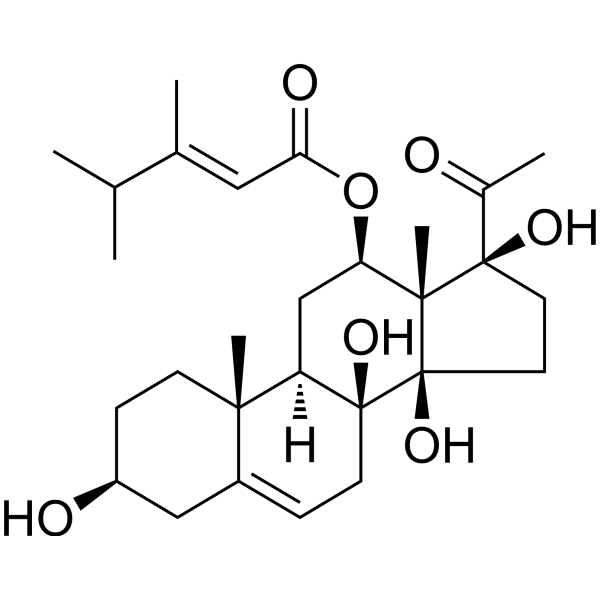
Caudatin is an orally active and brain-penetrant C-21 steroidal found in Cynanchum bungei decne with a variety of biological activities. Caudatin can inhibit cell proliferation, migration, invasion, cause cell phase arrest, induce apoptosis, autophagy, ROS prodution and loss of mitochondrial membrane potential. Caudatin activates PARP, caspase-3, -7, -9, upregulates pro-apoptotic Bad and Bax and downregulates anti-apoptotic Bcl-2 and Bcl-XL. Caudatin suppresses VEGF, FAK phosphorylation, upregulates p21, p27, DR5 protein expression, activates the p38 MAPK, JNK and PPARα/TFEB-mediated autophagy-lysosomal signaling pathways. Caudatin can be used for the research of cancer, inflammation and neurological disease, such as glioma and Alzheimer's disease .
Cat. No.: HY-N8249
CAS No.: 168706-29-4
Cynandione A is an acetophenone that can be isolated from Cynanchum Wilfordii Radix. Cynandione A protects hepatocytes and cortical neurons from toxicity and improves neurological deficits in a rat model of cerebral ischemia. On the other hand, cynandione A has significant anti-inflammatory effects and inhibits inflammation by activating macrophage α7 nAChR and IL-10 expression .
Cat. No.: HY-N1983R
CAS No.: 38395-02-7
Caudatin (Standard) is the analytical standard of Caudatin (HY-N1983). This product is intended for research and analytical applications. Caudatin is an orally active and brain-penetrant C-21 steroidal found in Cynanchum bungei decne with a variety of biological activities. Caudatin can inhibit cell proliferation, migration, invasion, cause cell phase arrest, induce apoptosis, autophagy, ROS prodution and loss of mitochondrial membrane potential. Caudatin activates PARP, caspase-3, -7, -9, upregulates pro-apoptotic Bad and Bax and downregulates anti-apoptotic Bcl-2 and Bcl-XL. Caudatin suppresses VEGF, FAK phosphorylation, upregulates p21, p27, DR5 protein expression, activates the p38 MAPK, JNK and PPARα/TFEB-mediated autophagy-lysosomal signaling pathways. Caudatin can be used for the research of cancer, inflammation and neurological disease, such as glioma and Alzheimer's disease .
Cat. No.: HY-N3672
CAS No.: 97399-96-7
Cynatratoside A, an oligoglycoside, is a nature product that could be isolated from the roots of Cynanchum paniculatum .
Cat. No.: HY-125545
CAS No.: 143502-52-7
Cynanester A is a active product that can be isolated from Cynanchum chinense R. Br. .
Cat. No.: HY-N0581
CAS No.: 106644-33-1
Qingyangshengenin A, a C-21 steroidal glycoside isolated from the roots of Cynanchum otophyllum Schneid, has antiepileptic activity .
Cat. No.: HY-N13318
CAS No.: 1015447-52-5
Otophylloside L is a pregnane glycosides isolated from the roots of Cynanchum otophyllum. Otophylloside L can be used in epilepsy research .
Cat. No.: HY-N13315
CAS No.: 1015447-50-3
Otophylloside J is a pregnane glycosides isolated from the roots of Cynanchum otophyllum. Otophylloside J can be used in epilepsy research .
Cat. No.: HY-N13317
CAS No.: 1015447-48-9
Otophylloside H is a pregnane glycosides isolated from the roots of Cynanchum otophyllum. Otophylloside H can be used in epilepsy research .
Cat. No.: HY-N3946
CAS No.: 849201-84-9
Synonyms: Glaucogenin C O-β-D-thevetopyranoside
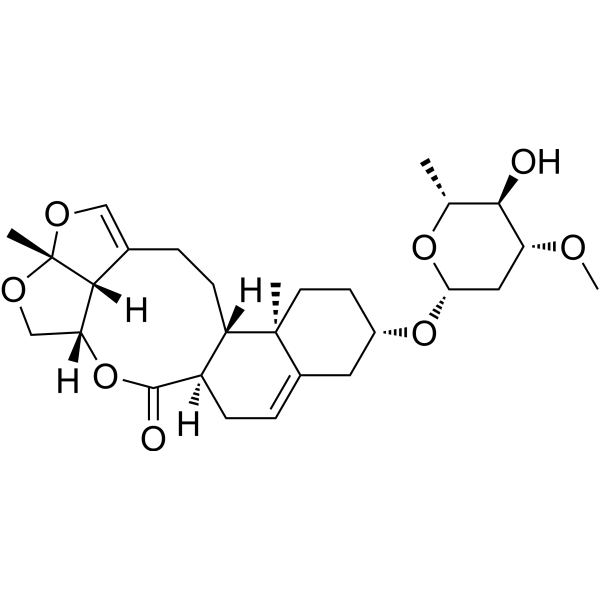
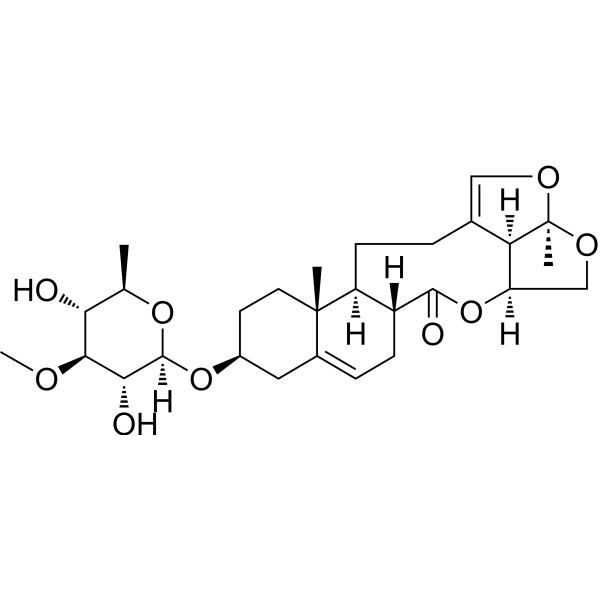
Glaucogenin C mono-D-thevetoside can be isolated from the roots of Cynanchum stauntonii .
Cat. No.: HY-N12373
CAS No.: 97399-99-0
Cynatratoside D is a oligoglycoside isolated from the root of Cynanchum atratum Bunge (Asclepiadaceae) .
Cat. No.: HY-N12816
CAS No.: 1021362-93-5
Glaucogenin C 3-O-α-L-cymaropyranosyl-(1→4)–β-D-digitoxopyranosyl-(1→4)-β-D-Canaropyranoside is a steroidal glycoside and can be isolated from Cynanchum stauntonii .
Cat. No.: HY-N12720
CAS No.: 1800029-53-1
Cynanoside J is a C21 steroidal glycosides that can be obtained from Cynanchum taihangense. The IC50 values of Cynanoside J for HL-60, THP1, and Caco2 are 6.38, 5.82, and 6.76 μM, respectively. Cynanoside J can be used in cancer research .
Cat. No.: HY-N18008
CAS No.: 1326583-11-2
Otophylloside P is a pregnane glycosid. Otophylloside P can be isolated from the roots of Cynanchum otophyllum .
Cat. No.: HY-N18393
CAS No.: 88797-64-2
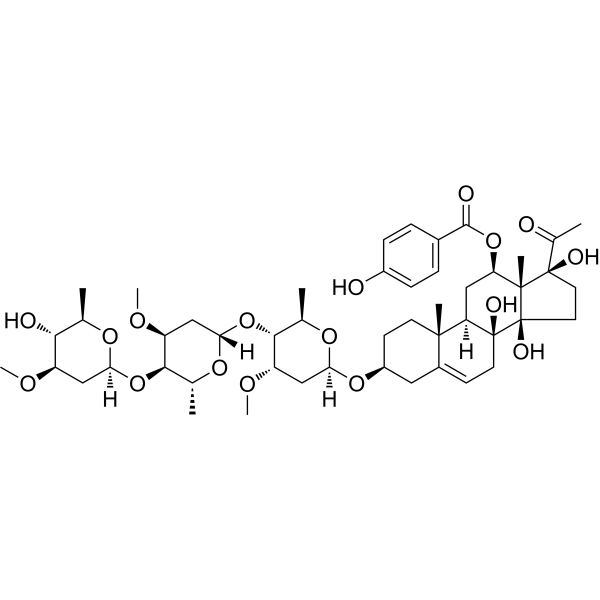
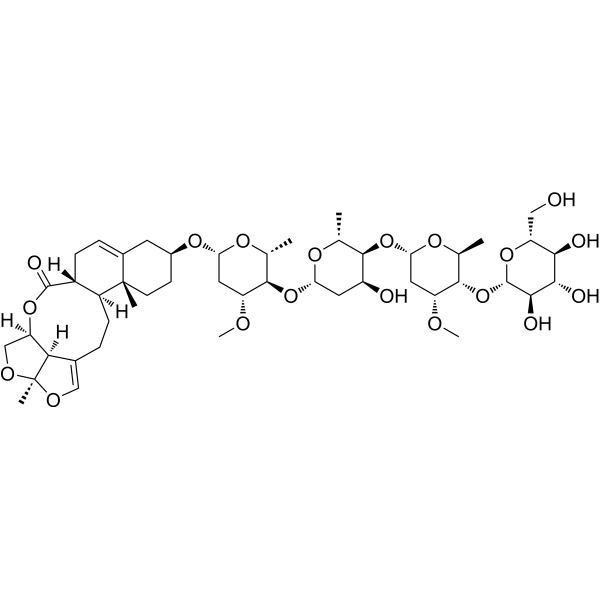
Caudatin 3-O-β-D-glucopyranosyl-(1→4)-β-D-oleandropyranosyl-(1→4)-β-D-cymaropyranosyl-(1→4)-β-D-cymaropyranoside (compound 6) is a C-21 steroidal glycoside that can be isolated from the roots of Cynanchum otophyllum and Cynanchum caudatum .
Cat. No.: HY-N2956
CAS No.: 6985-35-9
Bourjotinolone A is a Triterpenoids product that can be isolated from the barks of Phellodendron chinense Schneid. .
Cat. No.: HY-N2648
CAS No.: 116498-58-9
5,5'-Dimethoxylariciresinol is a Lignans product that can be isolated from the barks of Phellodendron chinense Schneid. .
Cat. No.: HY-N18046
CAS No.: 1326583-13-4
Otophylloside Q is a pregnane glycoside (C-21 steroidal glycoside) isolated from the roots of Cynanchum otophyllum. With caudatin (HY-N1983), an anticancer agent, as its aglycone, Otophylloside Q contains a sugar chain composed of cymarose, oleandrose and glucose units .
Cat. No.: HY-N12380
CAS No.: 1537167-62-6
Stauntoside M is a steroidal glycoside that can be isolated from the Roots of Cynanchum stauntonii .
Cat. No.: HY-N12817
CAS No.: 2128277-55-2
Anti-inflammatory agent 80 (Compound 2/2f) is an anti-inflammatory agent and has anti-tumor activity. Anti-inflammatory agent 80 can be isolated fromCynanchum limprichtiiSchltr .

